Why 87% of memecoin traders lose money (data from 500 wallets)
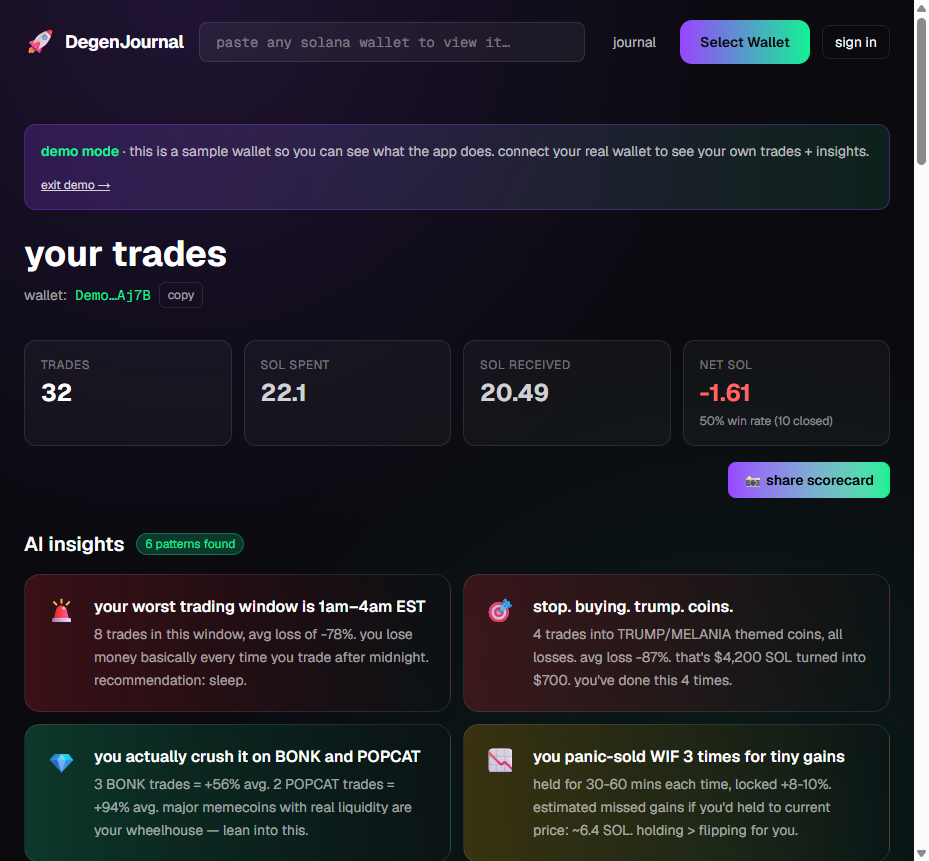
If you have ever stared at your portfolio at 4am wondering why do memecoin traders lose money when the charts felt so obvious an hour ago, congratulations, you are the target audience. I am one of you. I blew a genuinely respectable SOL bag not because I was dumb, but because I was consistent — consistently doing the same five things wrong, over and over, and never once writing them down. This article is about the actual memecoin trading statistics behind that, and the specific patterns that quietly turn a good week into a Coinbase-refill week.
Let me be honest about something up front, because you deserve it and because the internet is drowning in fake authority. I do not have a peer-reviewed, 500-wallet academic study with error bars and a DOI. I am not going to wave a research paper in your face that does not exist. What I have is the reality of building a tool that reads a lot of Solana wallets, plus decades of real, boring, well-documented research on how retail traders behave. So when I throw a number at you in this piece, I will tell you whether it is a real finding from real researchers or an illustrative example of the kind of pattern we see. If that ruins the fantasy that some guy on the internet cracked the code, good. The guys who claim they cracked the code are the ones selling you the code.
The part where I blew my bag
Here is the story, unedited. I hit a 6x on some dog coin early one week and felt like a genius. Genius money does genius things, so I stopped taking profit and started sizing up. By Thursday I was up big on paper and had decided I was simply better at this than other people. Then Friday night happened. I had a few drinks, I was tired, a new "narrative" was pumping in a Telegram I barely trusted, and I aped a coin with maybe eighty grand of liquidity at 2am because the chart was vertical and I did not want to miss it.
You already know the ending. The liquidity that let me in did not let me out at anything close to the same price. My own exit order moved the market against me. By the time I sold I had given back the 6x and then some, and I had done it while telling myself I was "managing risk." I was not managing anything. I was gambling with extra steps and a candlestick chart for decoration.
The worst part was not the loss. The worst part was that when I finally sat down and looked at my full trade history, I realized I had done that exact sequence — win, get cocky, ape tired into thin liquidity, give it all back — at least four separate times that year. I remembered maybe one of them. That is the real enemy. Not the market. Your memory, which is a lying little PR agent that only reports the trades that make you feel good.
The reality of the data (the honest version)
Let me give you the real research, in general terms, without inventing precise figures.
First, the classic work on active traders. Barber and Odean spent years studying the actual brokerage records of tens of thousands of individual investors, and the headline that comes out of that body of research again and again is unkind: the large majority of active retail traders underperform a simple buy-and-hold benchmark, and the more they trade, the worse they tend to do. Their famous framing is basically "trading is hazardous to your wealth." That is not a memecoin study — it predates memecoins by a long time — but the human behavior it documents is the exact behavior that memecoins turbo-charge.
Second, crypto specifically. The Bank for International Settlements published a bulletin in 2022 looking at retail crypto app usage, and one of its notable conclusions was that a majority of retail users likely lost money on their bitcoin holdings, in part because so many of them bought when prices were high and headlines were loud. Read that again: this is bitcoin, the most established, most liquid, least degenerate asset in the entire space. If the majority lost there, sit with what that implies for coins that did not exist last Tuesday.
Third, and this one is just math, not a study. Memecoin trading is negative-sum. Every entry and exit on Solana bleeds priority fees. MEV bots sandwich your swaps. Liquidity providers and snipers take their cut. The token itself usually has no cash flow, no revenue, no floor — it is pure "greater fool" until it is not. So before any skill enters the equation, the entire table is paying a tax to exist. In a negative-sum game, "most participants lose" is not a scandal or a conspiracy. It is the default outcome. You have to be actively good to overcome the drag, and most people are not measuring themselves well enough to even know if they are.
So where does "87%" come from? It is a headline, not a lab result. Think of it as a stand-in for "the overwhelming majority," which is exactly what the real research above supports. The specific patterns below are what we see across the wallets DegenJournal analyzes — illustrative of how the losing happens, not a controlled experiment with a fake confidence interval.
The 5 patterns that actually kill memecoin traders
Here is the useful part. "Most people lose" is not actionable. How they lose is. Across the wallets this tool reads, the same five patterns show up so often it is almost funny. None of them require a genius to fix. All of them require you to actually look, which is the one thing nobody wants to do.
1. Time-of-day tilt: you are trading tired, drunk, or both
This is the one that got me, so it goes first. When you plot a lot of traders' PnL against the clock, a pattern tends to fall out: there is usually a window where they are just bad. For a huge number of people that window is late night. You are tired, your judgment is fried, the day-job stress has drained your discipline, maybe you have had a drink, and the market that never sleeps is happy to take the trade.
Here is an illustrative example of what this looks like on a scorecard: a trader whose overall record is roughly break-even, but whose trades placed between roughly 1am and 4am are deeply, consistently red — while their daytime trades are actually fine. Same person. Same "skill." The only variable that changed was the clock and the state of their brain. That is not a strategy problem. That is a scheduling problem. And you cannot fix a scheduling problem you have never measured, because at 3am you feel exactly as smart as you do at 3pm. You are not. Nobody is.
2. Low-liquidity bias: you keep aping sub-$100k liq
Thin liquidity is seductive because it is where the 50x lives. It is also where the -95% lives, and where your own order becomes your enemy. When you buy into a pool with, say, under a hundred grand of liquidity, you are moving the price on the way in and you will move it against yourself on the way out. Add a sniper bot or two and a dev who can pull, and the "opportunity" is often just a well-lit trap.
The pattern we see is that a lot of traders have a systematic low-liquidity bias they do not know about. Their biggest, most exciting-looking entries cluster in the thinnest pools, and those are precisely the entries that produce their worst realized outcomes once you account for slippage on the exit. Not every one — you will remember the one micro-cap that 20x'd forever. You will not remember the eleven that quietly ate 60% each. This is where read-only wallet data is brutal in a good way: it shows the whole distribution, not the highlight reel. If you want to see exactly what your funds are exposed to without ever giving anyone control of them, that is the whole point of read-only analysis (no risk to your funds) — it reads, it never touches.
3. Theme fatigue: the same narrative, over and over, into the ground
Every trader has a narrative they are married to. Dog coins. Cat coins. AI agents. Politics. Some celebrity's latest embarrassment. The first time a narrative runs, the early people make money. The problem is that your brain files "I made money on this theme" as "I am good at this theme," and you keep replaying it long after the edge is gone and the whole timeline has moved on.
This is theme fatigue, and it is one of the most quietly expensive patterns there is. As an illustrative example: imagine your scorecard shows that political-themed coins are running at something ugly like -80% or worse for you specifically, across a dozen trades, while you keep buying the next one because the first one printed six months ago. That is the tool being blunt with you: this narrative is dead for your wallet, stop feeding it. "Trump-themed coins are -91% for you. Stop. Just stop." That line lands because it is the kind of thing your own data would say to your face if it could talk. The specific coins change; the fatigue is real and it is measurable.
4. Panic-selling winners too early
Now the flip side, and it is the one that hurts the most emotionally. You finally catch a real one. It is up 3x and climbing. And your hands, shaking with the memory of every giveback, sell the whole thing — right before it does the 15x you were early enough to catch. You did the hard part. You found it, you sized it, you were right. Then fear stole 80% of the payoff.
Cutting a winner at 3x when your average big win needs to run further to pay for all your losers is not "taking profit," it is capping your upside in a game where the upside is the entire point. Memecoin trading has a fat-tail payoff structure: a small number of monster runners are supposed to cover a sea of small losses. If you systematically panic-sell the runners early, you have quietly removed the only mechanism that makes the whole strategy work, while keeping all the losses. This pattern almost never shows up in memory because a 3x feels like a win. On the scorecard it shows up as "your winners are way too small relative to your losers," which is a very different and much more honest story.
5. Holding losers: no exit plan, just hope
And the twin of panic-selling winners is refusing to sell losers. You buy something, it dumps 40%, and instead of taking the L you decide you are now a "long-term holder" of a coin you would not buy today at any price. There is no plan. There is no invalidation level. There is just a bag and a feeling. You are not investing, you are hostage-negotiating with a chart, and the chart does not negotiate.
The data pattern is depressingly clean: winners get sold fast, losers get held forever. It is loss aversion doing exactly what the textbooks say — a loss you have not realized does not feel real, so you avoid the pain by pretending it is not happening, while it quietly rots to zero. The fix is embarrassingly simple and nobody does it: decide your exit before you enter. Where does this thesis die? At what price are you wrong? Write it down before you have money on the line and emotions in the driver seat. If you cannot answer that before you buy, you do not have a trade, you have a wish.
What actually works (it is boring, sorry)
Here is the anticlimax. The thing that works is not a secret indicator, a paid alpha group, or a bot. It is the least sexy word in trading: process. Three parts, all of which the losing version of me refused to do.
One: journal your trades. Not in a diary. Just capture what actually happened — entries, exits, times, liquidity, the narrative you were chasing, and ideally one honest sentence about why you clicked. The reason this matters is the thing I said at the top: you made dozens of trades this week and you remember maybe six of them, and they are the wrong six. A journal is just external memory that cannot lie to protect your ego. If you want the low-friction version of this on Solana, that is exactly what a proper setup is for — here is a walkthrough on how to start journaling your trades without turning it into a second job.
Two: write rules that block your two worst patterns. Not twenty rules. Two. Whatever your data says is bleeding you most. If it is the 3am thing, the rule is "no entries after midnight, no exceptions, close the app." If it is thin liquidity, the rule is a hard minimum liquidity floor for entries. If it is theme fatigue, the rule is "no more of narrative X until it prints for me again." Rules only work when they are specific, few, and aimed at a pattern you have actually confirmed — otherwise they are just vibes with extra confidence.
Three: review weekly. Fifteen minutes, once a week, looking at the scorecard instead of the timeline. Did the rules hold? Did the pattern shrink? What is the new worst thing? This is the whole loop. Measure, find your two worst patterns, block them, review, repeat. It compounds. And unlike a hot tip, it keeps working after the current meta dies.
One more boring thing nobody plans for, since we are being honest about where money actually goes: if you do start winning, the tax bill is real and it is worse than you think, especially with hundreds of tiny swaps to reconcile. Future-you will be very grateful that present-you read about the tax bill nobody plans for before April turns into a forensic accounting nightmare.
The uncomfortable summary
So, why do memecoin traders lose money? Because the game is negative-sum before anyone even shows up, because the well-documented reality is that most active retail traders underperform, and because on top of that structural drag we pile five deeply human, deeply avoidable patterns: trading tired, aping thin liquidity, replaying dead narratives, panic-selling winners, and marrying losers. The market takes its cut no matter what. The five patterns are the part you actually control, and almost nobody looks at them because looking is uncomfortable and the highlight reel in your head feels so much nicer.
You do not have to become a monk. You just have to stop being surprised by your own behavior. The traders who claw their way onto the right side of these statistics are not smarter — they are simply the ones who write it down and read it back.
See your own patterns
You can keep guessing, or you can look. Paste a public wallet and let it read your history read-only — it never touches your funds and never asks for a key — and watch your own worst windows, your liquidity bias, and your theme fatigue show up on a shareable scorecard. Poke around a live version first with the demo dashboard to see exactly what it surfaces, then run your real wallet and start your journal. Stop blowing your SOL bag on patterns you could have seen coming. The data is already on-chain. All you have to do is stop looking away.
Key takeaways
- Losses cluster in a handful of repeated behaviours, which means they are measurable and fixable.
- Revenge trading after a loss is the single most expensive pattern — position size usually spikes right after a red day.
- Round-tripping (holding a large gain all the way back to break-even) costs more than most outright losses.
- Fees and slippage on Solana are small per trade but brutal at high trade counts.
- You cannot spot any of these in real time — only across your own trade history, after the fact.
FAQ
Do most memecoin traders actually lose money?
The honest answer is that most active retail traders lose money over time, and memecoins are the most negative-sum corner of that world. Decades of academic research on day traders point the same direction, and memecoins add worse liquidity, higher fees, and faster rug risk on top. Assume the base rate is brutal until your own reviewed data proves you are the exception.
What percentage of crypto traders are profitable?
Nobody has a clean universal number, and anyone quoting you an exact percentage as gospel is guessing. What we do have: a 2022 Bank for International Settlements bulletin estimated a majority of retail crypto-app users likely lost money on their bitcoin holdings, and classic studies of active day traders show only a small minority stay net profitable after costs. Treat most lose as the safe assumption.
Why do memecoin traders lose money specifically, versus other assets?
Memecoins stack every disadvantage: thin liquidity so your own order moves price, priority fees and MEV skimming every entry and exit, near-zero fundamental floor, and a design that rewards impulse. Then human patterns finish the job — trading tired, chasing dead narratives, and panic-selling winners while marrying losers.
How do I stop losing money on memecoins?
Start by measuring instead of vibing. Import your wallet read-only, look at when you trade, what liquidity you enter, which narratives you keep replaying, and how you actually exit. Then write rules that block your two worst patterns and review your trades weekly. Boring, but it is the only thing that has ever moved the needle.
Is a trading journal actually worth it for memecoins?
Yes, because memecoin trading is high-frequency and high-emotion, which is exactly the environment where memory lies to you. You made dozens of trades this week and remember a handful, usually the wrong handful. A journal turns 'I think I trade fine' into evidence you can argue with.
Does DegenJournal touch my funds or need my private keys?
No. You paste a public wallet address and it imports your trade history read-only. It never asks for your seed phrase or private key and it cannot move, sign, or spend anything. It reads what already happened on-chain and shows you the patterns.
Are the numbers in this article from a real 500-wallet study?
No, and I say so plainly in the piece. The 500 wallets framing reflects patterns we see building the tool across the wallets it analyzes — illustrative, not a peer-reviewed controlled study. The general 'most active traders lose' claim is backed by real, well-known research cited in the article.
Keep reading
Paste a public wallet and DegenJournal auto-imports your history — no signing, no keys, never touches your funds.